 Add to Chrome
 Add to Firefox
 Add to Edge
LoViF 2026 Challenge on Real-World All-in-One Image Restoration: Methods and Results
Apr 21, 2026
This paper presents a review for the LoViF Challenge on Real-World All-in-One Image Restoration. The challenge aimed to advance research on real-world all-in-one image restoration under diverse real-world degradation conditions, including blur, low-light, haze, rain, and snow. It provided a unified benchmark to evaluate the robustness and generalization ability of restoration models across multiple degradation categories within a common framework. The competition attracted 124 registered participants and received 9 valid final submissions with corresponding fact sheets, significantly contributing to the progress of real-world all-in-one image restoration. This report provides a detailed analysis of the submitted methods and corresponding results, emphasizing recent progress in unified real-world image restoration. The analysis highlights effective approaches and establishes a benchmark for future research in real-world low-level vision.

Not All Queries Need Deep Thought: CoFiCot for Adaptive Coarse-to-fine Stateful Refinement
Mar 09, 2026Scaling test-time computation enhances LLM reasoning ability but faces a uniform computation paradox. Allocating identical resources leads to over-correction on simple tasks and insufficient refinement on complex ones. To address this, we propose CoFiCot, a coarse-to-fine adaptive framework that dynamically tailors inference strategies to problem difficulty. Specifically, we implement a multi-metric classifier that triages queries by synthesizing semantic entropy, consensus reliability, and predicted reasoning depth . This enables a differentiated refinement stage that applies efficient aggregation for simple queries while routing complex ones to a context-aware correction loop . We formalize correction as a stateful sequential propagation process , where each repair is strictly conditioned on the verified history of prior rectifications. By integrating Process Reward Models (PRMs) within this state-dependent trajectory, CoFiCot effectively bridges the gap between granular error localization and global logical coherence, preventing the context fragmentation typical of stateless refinement methods.
Prism: Spectral-Aware Block-Sparse Attention
Feb 09, 2026Block-sparse attention is promising for accelerating long-context LLM pre-filling, yet identifying relevant blocks efficiently remains a bottleneck. Existing methods typically employ coarse-grained attention as a proxy for block importance estimation, but often resort to expensive token-level searching or scoring, resulting in significant selection overhead. In this work, we trace the inaccuracy of standard coarse-grained attention via mean pooling to a theoretical root cause: the interaction between mean pooling and Rotary Positional Embeddings (RoPE). We prove that mean pooling acts as a low-pass filter that induces destructive interference in high-frequency dimensions, effectively creating a "blind spot" for local positional information (e.g., slash patterns). To address this, we introduce Prism, a training-free spectral-aware approach that decomposes block selection into high-frequency and low-frequency branches. By applying energy-based temperature calibration, Prism restores the attenuated positional signals directly from pooled representations, enabling block importance estimation using purely block-level operations, thereby improving efficiency. Extensive evaluations confirm that Prism maintains accuracy parity with full attention while delivering up to $\mathbf{5.1\times}$ speedup.
WildGraphBench: Benchmarking GraphRAG with Wild-Source Corpora
Feb 03, 2026Graph-based Retrieval-Augmented Generation (GraphRAG) organizes external knowledge as a hierarchical graph, enabling efficient retrieval and aggregation of scattered evidence across multiple documents. However, many existing benchmarks for GraphRAG rely on short, curated passages as external knowledge, failing to adequately evaluate systems in realistic settings involving long contexts and large-scale heterogeneous documents. To bridge this gap, we introduce WildGraphBench, a benchmark designed to assess GraphRAG performance in the wild. We leverage Wikipedia's unique structure, where cohesive narratives are grounded in long and heterogeneous external reference documents, to construct a benchmark reflecting real-word scenarios. Specifically, we sample articles across 12 top-level topics, using their external references as the retrieval corpus and citation-linked statements as ground truth, resulting in 1,100 questions spanning three levels of complexity: single-fact QA, multi-fact QA, and section-level summarization. Experiments across multiple baselines reveal that current GraphRAG pipelines help on multi-fact aggregation when evidence comes from a moderate number of sources, but this aggregation paradigm may overemphasize high-level statements at the expense of fine-grained details, leading to weaker performance on summarization tasks. Project page:https://github.com/BstWPY/WildGraphBench.
A-RAG: Scaling Agentic Retrieval-Augmented Generation via Hierarchical Retrieval Interfaces
Feb 03, 2026Frontier language models have demonstrated strong reasoning and long-horizon tool-use capabilities. However, existing RAG systems fail to leverage these capabilities. They still rely on two paradigms: (1) designing an algorithm that retrieves passages in a single shot and concatenates them into the model's input, or (2) predefining a workflow and prompting the model to execute it step-by-step. Neither paradigm allows the model to participate in retrieval decisions, preventing efficient scaling with model improvements. In this paper, we introduce A-RAG, an Agentic RAG framework that exposes hierarchical retrieval interfaces directly to the model. A-RAG provides three retrieval tools: keyword search, semantic search, and chunk read, enabling the agent to adaptively search and retrieve information across multiple granularities. Experiments on multiple open-domain QA benchmarks show that A-RAG consistently outperforms existing approaches with comparable or lower retrieved tokens, demonstrating that A-RAG effectively leverages model capabilities and dynamically adapts to different RAG tasks. We further systematically study how A-RAG scales with model size and test-time compute. We will release our code and evaluation suite to facilitate future research. Code and evaluation suite are available at https://github.com/Ayanami0730/arag.
MRG-R1: Reinforcement Learning for Clinically Aligned Medical Report Generation
Dec 18, 2025Medical report generation (MRG) aims to automatically derive radiology-style reports from medical images to aid in clinical decision-making. However, existing methods often generate text that mimics the linguistic style of radiologists but fails to guarantee clinical correctness, because they are trained on token-level objectives which focus on word-choice and sentence structure rather than actual medical accuracy. We propose a semantic-driven reinforcement learning (SRL) method for medical report generation, adopted on a large vision-language model (LVLM). SRL adopts Group Relative Policy Optimization (GRPO) to encourage clinical-correctness-guided learning beyond imitation of language style. Specifically, we optimise a report-level reward: a margin-based cosine similarity (MCCS) computed between key radiological findings extracted from generated and reference reports, thereby directly aligning clinical-label agreement and improving semantic correctness. A lightweight reasoning format constraint further guides the model to generate structured "thinking report" outputs. We evaluate Medical Report Generation with Sematic-driven Reinforment Learning (MRG-R1), on two datasets: IU X-Ray and MIMIC-CXR using clinical efficacy (CE) metrics. MRG-R1 achieves state-of-the-art performance with CE-F1 51.88 on IU X-Ray and 40.39 on MIMIC-CXR. We found that the label-semantic reinforcement is better than conventional token-level supervision. These results indicate that optimizing a clinically grounded, report-level reward rather than token overlap,meaningfully improves clinical correctness. This work is a prior to explore semantic-reinforcement in supervising medical correctness in medical Large vision-language model(Med-LVLM) training.
LoPT: Lossless Parallel Tokenization Acceleration for Long Context Inference of Large Language Model
Nov 07, 2025Long context inference scenarios have become increasingly important for large language models, yet they introduce significant computational latency. While prior research has optimized long-sequence inference through operators, model architectures, and system frameworks, tokenization remains an overlooked bottleneck. Existing parallel tokenization methods accelerate processing through text segmentation and multi-process tokenization, but they suffer from inconsistent results due to boundary artifacts that occur after merging. To address this, we propose LoPT, a novel Lossless Parallel Tokenization framework that ensures output identical to standard sequential tokenization. Our approach employs character-position-based matching and dynamic chunk length adjustment to align and merge tokenized segments accurately. Extensive experiments across diverse long-text datasets demonstrate that LoPT achieves significant speedup while guaranteeing lossless tokenization. We also provide theoretical proof of consistency and comprehensive analytical studies to validate the robustness of our method.
MS-BART: Unified Modeling of Mass Spectra and Molecules for Structure Elucidation
Oct 23, 2025Mass spectrometry (MS) plays a critical role in molecular identification, significantly advancing scientific discovery. However, structure elucidation from MS data remains challenging due to the scarcity of annotated spectra. While large-scale pretraining has proven effective in addressing data scarcity in other domains, applying this paradigm to mass spectrometry is hindered by the complexity and heterogeneity of raw spectral signals. To address this, we propose MS-BART, a unified modeling framework that maps mass spectra and molecular structures into a shared token vocabulary, enabling cross-modal learning through large-scale pretraining on reliably computed fingerprint-molecule datasets. Multi-task pretraining objectives further enhance MS-BART's generalization by jointly optimizing denoising and translation task. The pretrained model is subsequently transferred to experimental spectra through finetuning on fingerprint predictions generated with MIST, a pre-trained spectral inference model, thereby enhancing robustness to real-world spectral variability. While finetuning alleviates the distributional difference, MS-BART still suffers molecular hallucination and requires further alignment. We therefore introduce a chemical feedback mechanism that guides the model toward generating molecules closer to the reference structure. Extensive evaluations demonstrate that MS-BART achieves SOTA performance across 5/12 key metrics on MassSpecGym and NPLIB1 and is faster by one order of magnitude than competing diffusion-based methods, while comprehensive ablation studies systematically validate the model's effectiveness and robustness.
Rec-RIR: Monaural Blind Room Impulse Response Identification via DNN-based Reverberant Speech Reconstruction in STFT Domain
Sep 19, 2025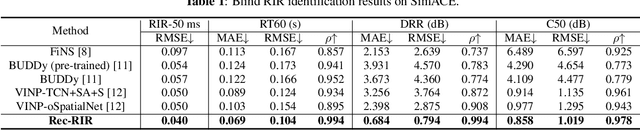
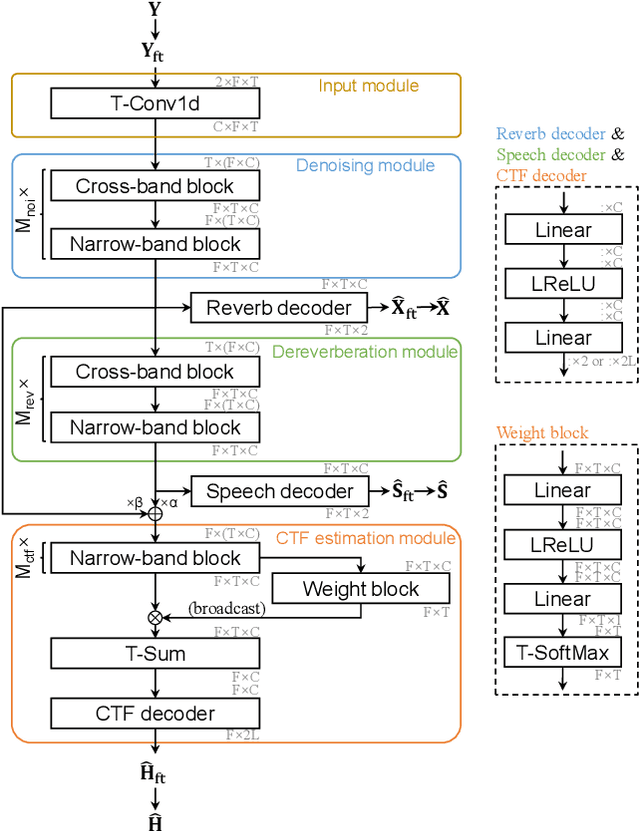
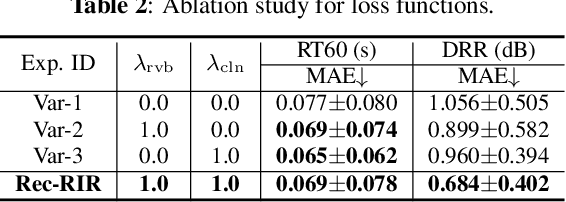
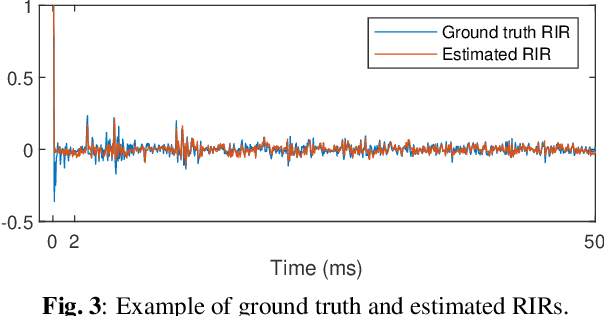
Room impulse response (RIR) characterizes the complete propagation process of sound in an enclosed space. This paper presents Rec-RIR for monaural blind RIR identification. Rec-RIR is developed based on the convolutive transfer function (CTF) approximation, which models reverberation effect within narrow-band filter banks in the short-time Fourier transform (STFT) domain. Specifically, we propose a deep neural network (DNN) with cross-band and narrow-band blocks to estimate the CTF filter. The DNN is trained through reconstructing the noise-free reverberant speech spectra. This objective enables stable and straightforward supervised training. Subsequently, a pseudo intrusive measurement process is employed to convert the CTF filter estimate into time-domain RIR by simulating a common intrusive RIR measurement procedure. Experimental results demonstrate that Rec-RIR achieves state-of-the-art (SOTA) performance in both RIR identification and acoustic parameter estimation. Open-source codes are available online at https://github.com/Audio-WestlakeU/Rec-RIR.
UnifiedVisual: A Framework for Constructing Unified Vision-Language Datasets
Sep 18, 2025Unified vision large language models (VLLMs) have recently achieved impressive advancements in both multimodal understanding and generation, powering applications such as visual question answering and text-guided image synthesis. However, progress in unified VLLMs remains constrained by the lack of datasets that fully exploit the synergistic potential between these two core abilities. Existing datasets typically address understanding and generation in isolation, thereby limiting the performance of unified VLLMs. To bridge this critical gap, we introduce a novel dataset construction framework, UnifiedVisual, and present UnifiedVisual-240K, a high-quality dataset meticulously designed to facilitate mutual enhancement between multimodal understanding and generation. UnifiedVisual-240K seamlessly integrates diverse visual and textual inputs and outputs, enabling comprehensive cross-modal reasoning and precise text-to-image alignment. Our dataset encompasses a wide spectrum of tasks and data sources, ensuring rich diversity and addressing key shortcomings of prior resources. Extensive experiments demonstrate that models trained on UnifiedVisual-240K consistently achieve strong performance across a wide range of tasks. Notably, these models exhibit significant mutual reinforcement between multimodal understanding and generation, further validating the effectiveness of our framework and dataset. We believe UnifiedVisual represents a new growth point for advancing unified VLLMs and unlocking their full potential. Our code and datasets is available at https://github.com/fnlp-vision/UnifiedVisual.